Tuesday, February 21, 2012

Last Three Weeks in Korea - Girls, Marines, & Dodgers


1. National
1) Girls’ Generation debut in the U.S.
Korean pop group Girls’ Generation made their U.S. debut by appearing on CBS’ David Letterman Show and ABC’s “Live!with Kelly”, creating a big buzz. The band’s performance of the English version of the “The Boys” on David Letterman show was met with enthusiasm from the U.S. fans. The video clip from the show received over 710,000 hits in just two days. More meaningful as it was Letterman’s 30th anniversary for his show on Jan 31 when the Korean girls wowed the old man. The Wall Street Journal described the Korean girls’ appearance in the David Letterman’s show as “inroad by K-pop in the U.S. market.”
The two industries most lopsided in trade in favor of the U.S. are aviation industry, and entertainment. Most of the Koreans well know Frank Sinatra, Whitney Houston or Tom Cruise, but how many Americans have heard of Cho Yongpil, Lee Mija, or Jang Dongkun? The Girls’ Generation were the first Korean entertainers featured in major U.S. TV stations to my memory, and many hope it would be the beginning of the correction of entertainment imbalance between the two countries.

2) U.S. Marines to be deployed in Korea
The U.S. has its Army, Air Force and Navy in Korea, but not Marines. This may change as a South Korean official said the U.S. has wanted to deploy some of the 8,000 marines and their families from Okinawa to Korea on a rotating basis. Korean government is worried about the opposition from China and North Korea as well as from some South Koreans, mostly because the marines are usually for attack instead of defense, even though it believes that the U.S. marines can play a major role in an emergency in Korean peninsula.


Korean marines are as tough and brutal as U.S. marines, thus keep strong pride in being a marine. As “Once a marine is a marine forever” is one of their favorite mottos, I asked two of my ex-marine managers if they would like to rejoin marines. F words came out of their mouth immediately. (See if you can find the two ex-MKL managers in the picture.)

2. Economy
1) A Korean firm interested in buying L.A. Dodgers
Korea’s E-Land Group has announced that it plans to buy L.A. Dodgers. According to market insiders, E-Land formed a consortium with Former Dodgers owner Peter O’Malley, Joe Torre, the former manager of N.Y. Yankees, and Magic Johnson. E-Land plans to invest $100 million in the deal. L.A. Dodgers is put out for sale as the current owner Frank McCourt needs some cash for his divorce settlement. E-Land is interested in Dodgers as it is the most loved baseball team to Koreans. Chanho Park, Korea’s first major leaguer, spent seven years there from 1994 to 2001. Los Angeles is the city with most Koreans in the U.S.


E-Land started its business in 1980, by opening a small 6 sqm clothing shop near E-Hwa Women’s university in Seoul. Its business has now grown to 8.7 trillion won ($7.9 billion won) in sales in 2011. Its original name was England, but changed to E-Land due to restriction on trademark registration. Just in case you might wonder whether E-Land is a Korean version of RE/MAX.

3. Auto Industry
1) Hyundai Mobis to supply GM and Chrysler
Hyundai Mobis has signed contracts worth $1.07 billion with GM and Chrysler. This is the 2nd largest amount Mobis signed with foreign automakers. Mobis will supply GM with integrated center stack system, a key component that controls multimedia terminals in the vehicle. It will supply LED tail lights to Chrysler. A Mobis executive said Mobis scored highly in the price-performance ratio of their products in an open bid against giants like Delphi. Mobis has supplied part to Daimler (audio systems and batter sensors), BMW(tail lights), Mitsubishi and Subaru (lamps) and GM (Parking brakes). The biggest contract Mobis signed for foreign automakers was for chassis modules worth $2 billion for Chrysler in 2009.


Who would have more say? HMC is the largest customer for Mobis, but Mobis is the largest shareholder of HMC with 21% ownership. Not all HMC suppliers have to say “how high?”

2) LG Group into automobile business?
With electric vehicles regarded as the future of auto industry, LG Group, Korea’s third largest Chaebol after Samsung and Hyundai, is considering making inroad into the auto business. LG Chemical is making investment to capture 25% of the battery market for electric vehicles, with the opening of its U.S plant in Michigan. V-ENS, a subsidiary of LG CNS, plans to build an electric vehicle component R&D center in Incheon by the end of this year. LG U Plus started car infortainment solution development, and LIG has begun to reinforce its auto insurance and vehicle repair business. Hyundai is apparently not very happy with the activities LG is unfolding. Hyundai decided to use SK batteries for its new Ray hybrid model, instead of LG batteries used in Sonata and Optima hybrid.
 
  
The group name LG was formed in 1995 to combine Lucky Chemicals, and Goldstar, an electronics company. Who knows. LG Chairman Mr. Koo might get a lucky and hit gold in auto business.

Regards,
H.S

Monday, January 30, 2012

Last Two Weeks in Korea - January 30, 2012

1. National
1) Students in Seoul got liberation?
   Seoul Education Superintendent Kwak No-hyun proclaimed the controversial students’ human rights ordinance that bans any kind of corporal punishment, continuing his clash with the central government and many parents and teachers nationwide. It took effect immediately in all elementary, middle and high schools in Seoul. It prohibits discrimination against students based on gender, religion, age, race, whether they are pregnant or because of their sexual identity. The ordinance allows students to stage rallies and loosens dress and hair codes in schools. The most controversial part of the ordinance is the banning of corporal and verbal punishments, which many parents and teachers say will lessen teachers’ authority and lead to students getting out of control. Critics say that Kwak does not understand the realities in the class rooms. 
The leftist Mr.Kwak was released from four months in jail last week after being fined 30 million won for election bribery last year, and he is the head of education in Seoul. Paris Hilton preaching teenagers to keep virginity until marriage ……  
2) Europeans image on Korea
Korea Trade-Investment Promotion Agency(KOTRA) asked 1,208 young people from 18 to 30 in five major cities in Europe what would come up as the first image when they think of Korea. North Korea was the first image with 9.1%, followed by K-Pop(6.9%) and Seoul (6.5%). Korean War was the fourth with 5.4% followed by Samsung(5.1%), Kimchi(2.7%), 2002 World Cup (2.4%), Taekwaondo (2.0%), science & technology (1.4%) and automobiles (1.4%).
 
What if the same question was asked to Americans who have not been to Korea?  Not sure, but M*A*S*H would be one of the top 3 answers.
2. Economy
1) Chaebol criticized over penetration into corner store business
It is like GE selling pan cakes and GM running coffee shops. While anti-corporate sentiment is brewing also in Korea due to widening wealth gap, President Lee Myungbak lashed out at third-generation scions of Chaebol owners for driving small business owners out of business, criticizing them for lacking business ethics. Lee added “If conglomerates keep invading into mom-and-pop stores, the public will harbor hatred against them.”  Big companies need act wisely.  Probably scared, Hotel Shilla announced it will walk away from its bakery and cafe brand Artisee just a day after Lee’s tough warning. Hotel Shilla is owned by Samsung Chairman’s first daughter.
While Korean conglomerates were the locomotive of Korean economy for over half a century, they have not been well respected as much by the public. An irony is that, while people accuse Samsung or Hyundai for being greedy and unethical, they want their kids get a job with Samsung or Hyundai.
3. Auto Industry
1) Chaebol criticized over penetration into corner store business
   HMC announced that its sister company Hyundai Powertech will supply its 6-speed transmission to Chrysler for its new Dodge Dart from 2012, with total volume of 770K to 2018. This will be 1.2 trillion won in sales. Hyundai worked together with Chrysler for the development of its World Engine produced in GEMA plant based on Hyundai’s Theta engine in 2005, so this will be the expansion of their cooperation in powertrain business.
  Hyundai Powertech was established in 2001 as the auto transmission company to supply to Hyundai and Kia. Located in Seosan city, one hour drive south west of Metaldyne Korea, Powertech celebrated its 10 million-th transmission on Dec 5 in 2011. Chung Myungcheol, the plant manager in Kia Slovakia plant until last month, is the new head of Hyundai Powertech. Mr.Chung, no relation to Chairman Chung Mongkoo, has spent most of his career in purchasing ever since he joined Hyundai 36 years ago. He has made the Slovakia plant a huge success, and Chairman Chung expects Mr.Chung repeat in Powertech what he did in Slovakia.
Regards,
H.S.

Tuesday, January 17, 2012

Last Two Weeks i n Korea - January 16, 2012

1. National
1) Cow farmers in protest at low prices
Angered by plummeting cow prices, cattle farmers tried to release hundreds of cows in front of Blue House, Korean version of White House, laying the blame on President Lee Myungbak and FTA with the U.S. he signed lately. They are shouting “Mr. Lee, you raise cow yourself!” Most of the farmers were blocked by the police on the highway before coming into downtown Seoul, though. The price of hanwoo (Korean beef) dropped 30% from its peak in 2009 to 4.4 million won ($3,800) per 600kg. There are total of 3.3 million live cows as of December, an increase from 2.9 million in 2009. The Agricultural Ministry said the right number would be around 2.6 million. To help the famers, the ministry said they would be replacing import beefs with hanwoo for consumption in the military.
As Korea has very small land the size of Indiana, with 70% of the land covered by mountains, Korean farmers would have hard time to compete if there is no protection against the low cost import beefs. The same story with chickens or pork. The only remaining livestock Korean farmers would still have clear advantage against the import would be, well, dogs.
2. Economy
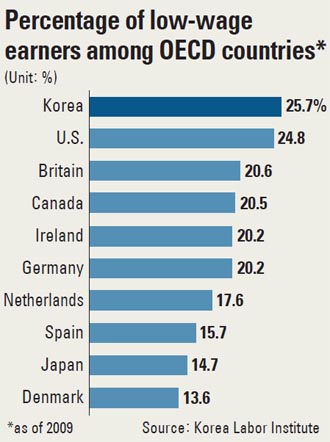
1) Korea with the most low wage earner ratio in OECD
Korea Labor Institute reported that the ratio of low wage earners stood at 25.7% as of 2009, the highest ratio among the 34 OECD nations. Low wage earners are full time employees who ear less than two-thirds of the median age. The U.S. and Britain followed with 24.8%, and 20.6%, respectively. The report said the countries with higher levels of GDP and records of steep economic growth tend to create such poorly paying jobs. KLI added that “In most nations, low-paying jobs are persistent and recurring issues that can widen income and wealth inequalities.”
The key to reduce the number of low-paid workers is to lift the minimum wage. Korea’s minimum wage in 2011 was 4,320won (U$3.76), and will increase by 6% to 4,580won (U$3.98) in 2012. This number should be correct as this info came straight from my son who is working as a part timer at an auto supplier during this winter vacation.
3. Auto Industry
1) Hyundai gets the best news in a row
Hyundai Chairman Chung Mong-koo must be all smiles these days. Hyundai ranked No.1 for the first time in 2012 JD Power’s Customer Retention Study with 64%, pushing the likes of Ford, Honda and BMW aside. Hyundai’s Elantra won 2012 Car of the Year award at Detroit Motor Show, edging out Ford’s Focus and VW’s Passat. Chairman Chung has been named the second most influential person in Motor Trend’s 2012 automotive power list after Chrysler’s Sergio Marchionne. Despite the recent success in sales and quality, however, Chairman Chung is determined not to repeat the Toyota mistake, and is pushing its plants and suppliers for ultimate quality level. The new head of purchasing vowed in the annual supplies’ convention last week that Hyundai will treat its suppliers to the quality level each supplier demonstrates.
 I got kicked around last week when HMC visitors complained about Metaldyne Korea being not clean enough for ultimate quality level. I told my wife about HMC’s complaint and Elantra winning car of the year award. I got kicked around again, with my wife demanding full 8D report to explain why the heck then I left Hyundai.
2) Hyundai and Bosch to end its joint venture
A Hyundai official said Hyundai is seriously thinking about ending the JV relationship over KEFICO, a powertrain management systems components maker Hyundai, Mitsubishi and Bosch jointly set up in 1987. He added that Hyundai is reviewing the relationship over the JV business, and that Hyundai will still maintain supplier relationship with Bosch. KEFICO is currently 50:50 owned as Bosch bought Mitsubishi’s 25% shares in early 2000. The Hyundai official admitted that there has been friction with Bosch as Bosch has kept raising issues about using the Bosch designed products in Hyundai models. Analysts think that, while the separation can be a proof Hyundai can stand on its own in key powertrain technologies, there is a risk that Hyundai may be falling behind in world leading technologies without Bosch.
Bosch better think about ending the JV with Hyundai. Many foreign suppliers dying to become a Hyundai supplier as Hyundai plans to make 7 million vehicles this year, world’s No.5 with Ford and Honda behind. Here are three easy ways to become a Hyundai supplier. Hit one of them, and you will get a purchase order immediately.
*Your product is priced about half of what Hyundai is paying to current suppliers.
*Your product has technology that Hyundai has to have to sell cars.
*Your president is a very good friend of Hyundai Chairman Chung.
Regards,
H.S.

Monday, December 19, 2011

The Last Two Weeks in Korea (December 19,2011)


1) A Korean coast guard killed by Chinese fisherman
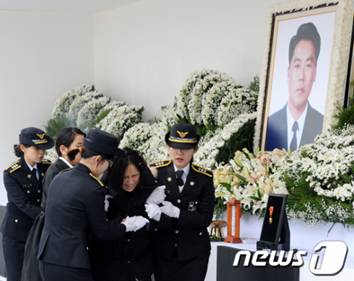
Cpl.Lee Cheong-ho, 41, a member of a Coast Guard SWAT Team, was stabbed to death by a Chinese fisherman in Yellow Sea. The SWAT team was in apprehension operation to seize an illegal Chinese fishing boat in Korean territory, and Lee got stabbed in the stomach by the captain of the boat. Cpl. Lee is leaving behind his wife and three kids. The captain and seven other fishermen were arrested on charges of murder. With mounting public anger against the Chinese fishermen, the Chinese government officially expressed regret over the killing. With fish not sufficient in the Chinese coast in Yellow Sea, mostly due to pollution, Chinese fishermen are tempted to throw nets in Korean sea.


The Chinese fishermen used to venture into North Korean waters frequently, but not any longer after two of them got killed by North Korean patrol boats a while ago. Probably one of few things Kim Jongil gets credit as you get picked on permanently unless you show your muscle.

2) Tension with Japan escalates after 1000th ‘Comfort Women’ protest
A statue of a ‘comfort woman’ forced into sexual slavery during WWII was set up to mark the 1,000th protest in front of the Japanese Embassy in Seoul. The first protest took place on Jan 8, 1992, and the comfort women have held protests every Wednesday since then. In March 2002, when the 500th demonstration was held, the Guinness Book of World Records put it as the longest regular protest of a specific issue. As many as 200,000 comfort women were sent to China, and 80% of them were Koreans. As time goes on, there are only 65 survivors, mostly 83 to 93 years old. The comfort women are demanding official apology, and full compensation from the Japanese government.  President Lee Myungbak met with Japanese PM Mr.Noda over this issue over the weekend. Mr.Noda asked the statue be removed, but Lee retorted that there can be the 2nd or the 3rd statue if the Japanese government keeps ears closed to the voices of the comfort women.


The rationale from the Japanese government is that Japanese government made a comprehensive compensation for its colonial rule over Korea by giving U$500 million to South Korea in 1965, and thus no more apologies or compensation is required. A little problem with that rationale is that the ‘comfort woman’ issue did not come up in 1965, as most of the comfort women were too ashamed to speak out for what they did. It would be very hard for a woman to say publically ‘I had given physical entertainment to thousands of Japanese soldiers.’

2. Economy
1) Good news for economy with a former Miss Korea’s scandal with her boyfriend?
Lots of voyeurism in Korea as Mr.Huh, a Taiwanese-American, put on his homepage the video clips of his private bed room activity with Ms.Han, a Miss Korea and anchor woman. They once lived together, but with the relationship going sour, Mr.Huh decided to release the video as a revenge for getting nearly beaten to death by gangsters hired by Ms.Han in March.  No comments yet from Ms.Han at this time. This is the third time a celebrity’s personal hardcore video was released to the public. First, it was Ms.Oh, an actress whose video went wild fire through diskettes in 1998, and it triggered home computer boom in Korea. The second was Ms.Baek, a singer, whose graphic scenes in 2000 spread around via internet, thus advancing home high speed LAN by 10 years. The latest Ms.Han’s video is floating around mostly in smart phones, so Samsung and Apple are in big smiles.


The ultimate victim from Ms.Han’s scandal was not Ms.Han herself, but the average Korean husbands. The video showed the greatness of the Taiwanese guy’s, and Korean wives keep comparing with their husbands’.

2) Korea in dilemma over Iran
What if my friend’s enemy is my friend? Korea reluctantly joined U.S. efforts for sanctions against Iran by adding more than 100 Iranian groups and individuals to its financial blacklist and cautioning local firms against purchasing Iranian petro products. With the stricter measure, the organizations and individuals will now have to receive approval from the Bank of Korea before making any foreign currency transactions.  The dilemma is, while Korea is a blood ally with the U.S., Korea has to rely on Iran nearly 10% of total oil imports.


Korea has traditionally been a good friend to Iran, even after Mr. Alphabet became the leader of Iran. The busiest street in Seoul stretching from Renaissance Hotel to Intercontinental Hotel is called “Teheran Street” after Seoul and Teheran made a sister city relationship in 1979, and many Korean companies, including auto makers, have strengthened their business relationship with Iranian partners.. There was no bloody past between the two countries to boot, thus no need to squabble over a statue.

3. Auto Industry
1) Hyundai beats Samsung in profits for the first time
Hyundai and Samsung have been perennial rivals for #1 in Korea for decades, and it was always Samsung with the most profit. It may change this year as Hyundai is expected to reap 18.05 trillion won(U$15.52 billion) in net profit in 2011, while Samsung will trail with 17.75 trillion won. Hyundai’s growth came from hot sales of Hyundai and Kia models after Tsunami in Japan in March, and Samsung’s fall was due to the poor performance of flagship company Samsung Electronics’ LCD business. While Hyundai trounced Samsung in profit, many analysts think Samsung is still the top as its total revenue would be more than Hyundai’s in 2011, and will retake #1 position in 2012 with the high sales of smart phones.


I have a personal vendetta against Samsung.  I applied for Samsung internship along with twenty of my classmates in senior year in 1986. All of my friends got the admission, but not me. For some reason, Samsung singled me out as a reject and I ended up with Hyundai Motor after senior year. I am thinking to release my secret personal video clips against Samsung;  My living room with Sony TV, LG refrigerator, Electrolux vacuum cleaner, Apple cell phone, but no Samsung whatsoever……

Regards,
H.S. 

Monday, November 21, 2011

Last two weeks in Korea (Nov 21, 2011)

1. National
1) Jeju Island chosen as one of world’s 7 wonders
After a yearlong campaign, Jeju Island, Korea’s Hawaii, was named one of the new 7 wonders of the natural world by New7Wonders Foundation. Other winners were the Amazon Forest, Halong Bay in Vietnam, Iguazu Falls, Komodo National Park, Puerto Princesa Underground River in Philippines, and Table Mountain in South Africa. There were 28 finalists including Grand Canyon and Dead Sea.  Located 80km from southern tip of Korean peninsula, Jeju has land size of 1,848 square kilometers with 577,187 people. The Jeju Development Institute expects that there will be an increase of 73.6% in foreign tourists and 8.5% in Korean tourists with the recognition as one of 7 natural wonders. 
The nomination by the New7wonders Foundation was somewhat controversial as the organization decided the winners from votes by internet and phone calls without restricting duplication. A person with lots of time to waste, and money to pay for phone calls could vote for Jeju 1 million times if he or she wanted. Thank God for Jeju governor not contacting my wife for her support.
2. Economy
1) Kim Jongil not happy with cookies to North Korean workers concerns
Kaeseong Industrial Complex is located north of DMZ where many South Korean companies have plants. Choco Pies, the chocolate-covered, marshmallow cake, are given to North Korean workers as snacks. A trouble occurred as some of the workers smuggle them outside the industrial zone and sell them in the black market. So popular among the North Koreans, the pies are viewed as dangerous symbols of capitalism by the North Korean authorities. Pyongyang demanded that South Korean companies stop giving out Choco Pies, and give cash to the workers instead.  The South Korean companies had a meeting over this issue, but failed to reach an agreement over how many Choco Pies each company can give to their North Korean employees.  
I had similar experience. Only super rich could afford to enjoy bananas in 1982 as the import of banana was banned to protect Korean farmers. I joined the army to work in the U.S. army base in Seoul at that time, and found that rare bananas were given at each meal. I saved my share of bananas in the locker, and took them out for my brother and sister over the weekend. Time has passed, and anyone can import bananas as many as they want. Even Korean monkeys go on hunger strike when they are given bananas.

2) Work shift pattern may change?
Most of the plants in Korean auto industry run two shifts. With one hour each for lunch and dinner, it is 8:00am to 8:00pm for day shift, and 8:00pm to 8:00am the following day for the night shift. Companies can benefit as they can run close to 24 hours, with one third less employees than 8 hour three shifts practiced in other countries. Employees were O.K too as they can work higher paying overtime. Things can change as GM Korea announced that they will have three shifts operation so that employee can have more time for rest. The government said they will demand Hyundai/Kia do the same thing for more job creation and employee health.

GM Korea plans to do what works best in the nation its headquarter is located, without knowing the impact it will have on Korean OEMs or suppliers. When Hyundai opened its Bromont plant near Montreal in 1988, Hyundai gave free meals to its employees to follow the practice in Korea. The Canadian employees were so much happy, but other companies in Bromont were not, as they suddenly turned into a Scrooge compared to Hyundai. Hyundai had to change its policy, and began to charge $3.5 to the employees. The above pictures are Hyundai Bromont plant that is now closed.   
3. Auto Industry
1) Renault-Samsung gets a blue eye by golf bags
As most of golf courses are located outside Seoul in two hours drive range, the golfers tend to meet at a location and ride together in one car with all of their golf bags in the trunk. So it is very important that the trunk has to be big enough to hold minimum 4 golf bags as it has to be always four people to make one team. SK Encar, a used car dealer set up by SK Group, thus checked the size of 30 mid-size sedans sold in Korea, and said Renault Samsung’s top of the line SM7 and its smaller sister SM5 are no good for golfers as they could not take only three, not four golf bags. These two were the only local models that could not take four bags. Chrysler PT Cruiser was the worst as it could hold only 2 bags, while Ford’s new Taurus was the biggest with 5 bags.
SM 5 and SM 7 are designed by Renault-Nissan engineers who probably have small understanding of Korean way of thinking.  Another example is with North American cars in Korea.  Korea is small in land, and the parking lot is only 2.3m wide.  You park two 1,936mm wide Taurus side by side, and you have to wiggle out of the Taurus with doors only 15 centimeter open. (Sonata is 101mm narrower with 1835mm width.) Obama’s rhetoric wouldn’t help U.S cars sell better in Korea. It is American designer’s better understanding of Korean customs and realities.
2) Hyundai joins hands with GM over hydrogen fuel cell vehicle
According to local Herald Economy magazine, GM has signed a memorandum of understanding with Hyundai over joint development of future vehicles. A high ranking GM official said “GM’s top management has visited Hyundai headquarter in Seoul and R&D facility in Namyang last August, and proposed joint development if hydrogen fuel cell electric vehicle.”  A Hyundai official said Hyundai was positive to this proposal, thinking that it was a great accomplishment already to be proposed by a giant who spends 10 times more R&D money than Hyundai does. He said Hyundai Chairman Chung Mongkoo told his management to take a positive look at the GM proposal, and that official announcement can be made late this year or early next year.  Hyundai has supplied Seoul city with 19 Mohave and 14 Tucson models powered by hydrogen fuel cells.
 
Koreans call it “gemucee” to describe something big, powerful, and reliable, like gemucee refrigerator or gemucee Mike Tyson. Gemucee is how Koreans pronounce GMC, and this dates back to 1950s when Koreans were wowed by the performance of GMC military trucks during the Korean War. Koreans had only driven Japanese made vehicles run by charcoal until Gemucee trucks showed up in Korea. My brother in Hyundai probably hopes the latest joint development can result in Gemucee 2 that can wow the consumers all over the world this time.

Regards,
H.S.

Monday, November 7, 2011

Last two weeks in Korea (Nov 7, 2011)


1) Police chief urges lethal weapon on mafia gangsters
Angered by timid police response to quell sword wielding vicious fights between two rival mafia gangs in Inchon, Cho Hyunoh, the commissioner of the National Police Agency, declared war on organized crime rings, and permitted police to fire guns if necessary. While the police can carry guns, there have been strict and cumbersome rules to follow before firing actual bullets.  Asked about the possible human rights abuse with the quick use of guns, Cho said “no need for human rights for gangsters.” You can not tell mafia gangsters by normal appearance in Korea, but it will be much easier if they go naked as most of them have tattoos like below.
 I was in serious jeopardy on May 2, 1989, in Canada. A police man pulled me over when I drove fast not to miss the plane from Dorval Airport in Montreal for my marriage in Korea on May 5th.  I did exactly what I would do in Korea.  I opened the door and got out of my car, to explain the police man why I had to drive fast. Then, I put my right hand inside my jacket, just to take out my driver’s license from the pocket.  I had to learn hard way what “freeze” means on that day.

2) Inchon Airport gets the best airport award
Inchon International Airport was named on the inaugural “Roll of Excellence” by the Airports Council International, a federation of over 1,700 airports around the world. Inchon Airport received the praise after having been chosen as the world’s best airport for six consecutive years from 2006. The “roll of Excellence” was established this year, and airports that consistently made it to the top five for five years straight are eligible.
Inchon Airport is the best. Then what is the worst? It is O’Hare Airport in Chicago from my personal experience. I made a visit to the U.S thru O’Hare Airport last April, and it took me 1 hour and 10 minutes to pass the immigration due to long line, especially for foreigners. I returned to Korea a week later, and checked how long for immigration process at Inchon Airport. Just 2 minutes!  Because I was a Korean? It was 1 minute and 30 seconds for the foreigner who was in the same flight with me. O’Hare Airport can sue me any time if I added even a minute.

2. Economy
1) Korea-US FTA bill still under opposition
The FTA bill is going nowhere as the opposition party is now proposing to put it on the national referendum. The opposition Democratic Party Chairman, Sohn Hakkyu, took it to the streets handing out leaflets to build support for blocking the Korea-U.S. FTA. The Democratic Party is insisting that the ISD(Investor-State Dispute Settlement) provision in the bill has toxin inside against Korea, and is demanding the government to re-re-negotiate with the U.S. which already signed the bill. With the ruling Grand National Party showing reluctance to pass the bill in fear of ugly physical fight against DP lawmakers, and with the DP taking it as part of their strategy for the presidential election next year, it seems it may take a while for the bill to pass the National Assembly.
I’m in dilemma. Sohn Hakkyu was the governor of Gyeonggi province, and came to Metaldyne Korea at the grand opening ceremony in 2005. He belonged to Grand National Party at that time, and was a strong advocate of FTA with the U.S.  He then defected to Democratic Party in 2007 when he was losing presidential party nomination to current president Lee Myungbak. Sohn now plans to run for presidential election again next year as the leader of Taliban against the FTA. Should I vote for him or not?  Many millions of Koreans have the same dilemma as they also once thought Sohn could be the best leader in the nation.


3. Auto Industry
Hyundai-Kia Chairman Chung Mongku met with the Chinese officials from Yancheng city, and signed a contract to build Kia’s third plant with an annual capacity of 300,000 units in the city where Kia’s two existing plants are located.  The groundbreaking will take place at the end of 2012 for completion in 2014. Kia official said the third plant is need to catch up with fast growing Chinese market,  which rose to 11.12 million vehicles last year, up 34% from 2009.Once Kia’s third plant is completed, Hyundai-Kia will have capacity of 1.73 million units in China, 200,000 more than 1.53 million capacity in Hyundai’s main Ulsan plant in Korea
The tall man in dark suit next to Chairman Chung is Mr.Seol, a Chinese born in Korea. One of seven vice chairmen under Chairman Chung, Mr.Seol has been the main man for Hyundai’s China project since early 2000, and has done a pretty good job with all the success stories in China. A living proof of “no quanxi, no business “in China.

2) Hyundai union selects new leader more militant
While Mr.Chung was upbeat at the signing ceremony for Kia’s 3rd plant, he was probably much stressed out at the bad news over the weekend. One of the main reasons Hyundai was successful last three years was from the union leader who was reasonable enough to avoid perennial strikes in favor of practical benefits for union members. So no strike during his three year leadership.  This might change as Hyundai union members have selected Moon Yongmoon as the new leader for the next two years. Supported by infamous Korean Confederation of Trade Unions, a Korean version of UAW, Moon announced he will fight for the transfer of outsource workers to regular employee status, for the repeal of time-off system, and for two 8 hour consecutive shifts that will eliminate mid night working. All the bad stuffs that will give a direct impact to Hyundai’s profitability.
With Mr.Moon as the new union leader, Hyundai will face the reality again in which average three weeks a year can be wasted with strikes, much like what had been going on every year prior to three years ago. Many people in Hyundai management thus pray in despair that Mr.Moon somehow turn into another Sohn Hakkyu in Democratic Party, the master in about face.

Regards,
H.S.