Wednesday, August 1, 2012

LTW - True Beauty?, Math Olympic Gold, & a Powertrain


1. National
1) Controversy over Miss Korea’s true beauty
The movie “Face Off” starring John Travolta became a reality. This year’s beauty pageant winner Kim Yu-mi, who won the title of Miss Korea three weeks ago, has confessed that she was not born beautiful. Kim’s comments came as her photo in her high school yearbook had an extremely different look from what she wears now. Just in case you do not see the picture below, it was like Rosie O’Donnell turning into Paris Hilton. Kim said she understands people would be disappointed by the revelation, and that she hopes to make a name for herself for her inner beauty rather than her outer beauty. As Miss Korea is to compete in Miss Universe competition to represent the beauty of Koreans, many are saying Kim should be dethroned, and her runner up, who got no plastic surgery, should compete in Miss Universe event instead.

That no human beings are better than God was a true statement until Kim Yu-mi became a Miss Korea.  Kim’s plastic surgeon became a living proof that human beings are mightier than God.

2) Korean singer gets U.S. President’s volunteer Award
Singer Kim Jang-hoon won the U.S. President’s Volunteer Service Award for his 15 billion won charitable donations in Korea , which was most used to place pubic service ads in major U.S. newspapers, and for his donations in the U.S. charity organization, all of which boosted the Korea-U.S. friendship.  Kim’s public ads in the U.S. media were about Dokdo Island which Japanese call Takeshima, and East Sea also known as Sea of Japan. Maybe Kim’s efforts seem paying off as the French publisher of world’s most authoritative world atlases is using both names “Mer de l’est(East Sea) and “Mer du Japon (Sea of Japan)” in its 2012 version.

I personally think Kim Jang-hoon is an imbecile for putting ads in the U.S. newspapers, claiming “Dokdo belongs to Korea, not Japan.” Korea has occupied the island from 1948 with 40 policemen staying there, and any attempt by Japanese navy to take over Dokdo is tantamount to declaration of war. If Americans read Kim’s ads, they might think Dokdo is a disputed island. Mr.Kim! It is perfectly O.K with your East Sea ads in New York Times, but please stop ads on Dokdo immediately!

3) Korean students win Math Olympiad 1st time
Korean high school students won six gold medals to earn a total score of 209 points in the 53rd International Math Olympiad in Mar del Plata, Argentina, held from July 4th. They bat out Chinese team which came in 2nd with 195 points and the U.S. team, which ranked 3rd. This year’s competition involved 548 high school students from 100 nations. It was Korean team’s first victory since its first participation in 1988. North Korea ranked 12th with two gold medals, while Japan came in far behind in 17th place.  The math Olympiad, which was first held in Romania in 1959, is held in a different country every year, and it will be Santa Marta, Columbia next year. In 2009, Korean students also ranked first in math skills at the Program for International Student Assessment(PISA).
It is a shame that, despite all the Obama praise of Korean education system and victory in PISA and the International Math Olympiad, only one Korean got Nobel Prize,  late president Kim Daejung who won the Peace Prize in 2000 after his historic handshake with North Korea’s Kim Jongil while Japanese won 18 prizes.  Korea has a long shot for Nobel prizes unless Nobel committee creates its seventh category called Nobel Prize in Women’s Golf.

2. Economy
1) Apple ordered to advertise for Samsung
Samsung and Apple are engaged in an all out patent war all over the world.  A victory for Samsung came from Britain as the British court has ordered Apple to post a notice on its website and run ads in major British media, citing the court ruling that Samsung did not copy the iPad. Apple was clearly upset as its lawyer said “No company likes to refer to a rival on its website as it is tantamount to advertizing for Samsung.”  Apple has appealed the ruling. In other patent fight in Australia, the Australian judge urged both Samsung and Apple to settle their “ridiculous” dispute.

Not sure if Samsung can smile at British ruling. The British court ruled that “Samsung’s Galaxy Tab did not copy Apple’s design. Samsung’s tablets were unlikely to be confused with the iPad because Galaxy Tab is not as cool.”

3. Auto Industry
1) Korea Powertrain to supply 9 speed torque converters to ZF
Korea Powertrain announced that they will begin supplying torque converters for 9 speed transmissions to ZF Germany from 2013 until 2021 with total volume of 2.8 million units, totaling 1 trillion won ($871M) in sales . Because of the technical complexity of torque converters, Korean auto makers had to import them from overseas in the past. That changed in 1995 when Korea Powertrain began to manufacture torque converters for 4 speed transmissions. Korea Powertrain kept growing to take 95% of the market in Korea in 2011, and ZF decided to work with Korea Powertrain in 2010 for the development of its world’s first 9 speed transmission. Mr.In-Shik Joo, the CEO of the company, felt it a pity that he can not sell his torque converts to Hyundai yet as Hyundai still can not make 9 speed transmissions. Mr.Joo added that, with the supply to ZF and other overseas customers, his company’s sales will jump from 308 billion won in 2011 to 1 trillion won by 2020. A graduate of Hanyang University, Mr.Joo left Hyundai 1993 after 16 years in purchasing to establish Korea Powertrain.
    
Established in 1939 as Korea’s first engineering college, Hanyang University has produced many leaders in Korean business world, mostly in the manufacturing industries. Hanyang ranks No.2 in the number of CEOs in Korean companies and Mr.Mong-Koo Chung, the CEO of Hyundai and a graduate of Hanyang, has donated millions of dollars last year to build the “Future Automotive R&D Center” in Hanyang. My brother and I am also from Hanyang, just in case you are wondering why so much plug for Hanyang here.

2) Renault Samsung to make Rogue SUV for U.S. market
Carlos Ghosn, the CEO of Renault-Nissan, was in Korea to support Renault-Samsung Motors which has been suffering from falling sales. Ghosn announced that it will invest $160M in RSM to produce 80,000 units of Nissan’s Rogue models from 2014 for exports to the North American market. This is the first time in Korea that a car maker will be manufacturing vehicles for another brand solely for overseas market. The original plan was to have Nissan build the Rogue at its plant in the U.S., but Ghosn made a decision to make it in RSM to support the ailing company. Another reason for Ghosn decision was benefits from Korea’s FTA with the U.S. Ghosn said that Renault-Nissan Alliance is fully behind RSM as it is one of the most competitive plants.

Sales falling even behind Ssangyong Motors to rank last in Korea, the employees in RSM have been discouraged for months  It seems like their prayers to God, oops, to mightier Miss Korea’s plastic surgeon, for the survival have been finally answered with Carlos Ghosn’s visit to Korea.

Regards,
H.S.

Monday, July 16, 2012

LTW - NK Changes, Choi Champ, & Handcuff brouhaha

1. National
1) Wind of change in North Korea
The sun rose in the west in North Korea last week as Mickey Mouse, Winnie the Pooh have entertained North Korean officials, including Kim Jongun and his seemly wife, at a debut concert for the troupe, Moranbong whose members wore short skirts and revealing dress. Highlights and the theme song from “Rocky IV” were also played. Note Rock IV was Sylvester Stallone against Soviet boxer. Experts said the Swiss-educated young leader has different way of thinking from his late father, and just expressed his desire to improve relationship with the U.S. in the concert filled with American characters.
 
Walt Disney thought its intellectual property rights are no Mickey Mouse game as its spokesman said that nobody in North Korea had asked permission to use its characters. Kim Jong-un may retort that Disney violated his trade mark rights by inventing Winnie the Pooh character after copying his grandpa. (Kim Jon-un is joked as the smallest of three bear family among North Koreans.)

2) N.Y Choi wins U.S. Women’s Open
Korea’s Na-Yeon Choi won her first career major championship by capturing the U.S. Women’s Open at Blackwolf Run golf club in Wisconsin last week after beating another Korean Amy Yang by four shots. Choi is the 2nd straight Korean champion of the U.S. Women’s Open after So-yeon Ryu in 2011 and the sixth ever since Seri Pak won the title at the same Blackwolf Run in 1998. Choi thanked Seri Pak for being her spiritual mentor at the trophy awarding ceremony.
    
Choi’s win was a celebration for Daewon Foreign Language High School, as it was the school both Choi and Ryu attended. Choi is two years senior to Ryu who was my first son’s classmate. Despite short history with establishment in 1984, Daewon has become a top high school in Korea. It sends the most graduates to Seoul National University (Korean Harvard), and over 100 students to Ivy League or the same level schools in the U.S. every year. Daewon graduates are tiny cats now with its graduates still young, the oldest graduate being only 43 year old, but will become mighty tigers soon, roaming in forests in Korea and overseas in a few years.

3) Handcuff brouhaha in Pyeongtaik
Seven U.S. military policemen got into an argument with three Korean men over parking in front of Osan Airbase in Pyeongtaik, the same place World Hotel is located, and tried them take into the airbase after handcuffing them. Huge criticism came from all over the place, and there was a fear that it might be another “Anti American candle lights” triggered by the death of two Korean girls by a U.S. military tank during an exercise. American authority at that time looked at it as a simple traffic accident, which was right, and made no apology as they had no knowledge of Korean sentiment over death. (Koreans might mourn at the death of a serial killer.)  The commander of U.S. Forces in Korea made a right decision this time by making an apology saying, “I want to express my sincere apology to the individuals and community affected by the incident.” Things have quiet down quiet after the apology.
  
Working in an American company in Korea, I am often caught in the same dilemma. With all the internet and cultural exchange these days, there is clearly a big cultural gap between Korea and the U.S. Can Koreans understand American companies can stop supplying parts if they are not fairly treated?  Can Americans believe two Korean men can slow dance each other at a night club, and they are still straight?

2. Economy
1) SK Group fined for unfair aiding of its affiliate
SK Group, Korea’s 3rd largest conglomerate, got a fine of 30 billion won ($26.3M) for giving work to its affiliate, SK C&C, a system integration company. The seven SK Group companies were found to have paid SK C&C over 1.7 billion won in service fees since 2008, an unusually high amount, to support SK C&C mostly owned by SK Group owner’s family.  The amount was up to 72% more than other companies would pay to other system integration providers.  This was the first time the government has fined a top conglomerate for excessively supporting its sister company. Other big conglomerates, including Samsung and Hyundai, are also criticized for supporting their smaller affiliates owned by group owners, and this unfair practice is turning into a major issue in the presidential election in December.
 
If you have sharp eyes, you will notice the U.S. Open winner Na-yeon Choi is wearing a SK hat. SK’s original name was Sunkyoung. They changed it to SK in mid 1998, as foreigners thought Sunkyoung sounded like Sunk Young. Another Korean company that needs to change its name is Woori Bank, meaning “Our bank” in Korean. Foreigners may worry about depositing their own money in the Woori Bank.

3. Automotive
1) Doosan Infracore makes big deal with PSI in U.S.
Doosan Infracore announced that it has won a 98 billion won ($85.8 million) business to supply engine blocks and diesel engines to Power Solutions, Inc(PSI).  Doosan will deliver 4,400 engine long blocks to PSI by 2015. The engine long block consists of everything in engine except the fuel systems and ignition systems.  In a separate deal, Doosan Infracore will also supply 800 diesel engines to Clark Equipment within this year.
     
Doosan Infracore has its origin from Chosun Machinery established in 1937 during Japanese colonial days. It changed its name to Daewoo Heavy Industry when Daewoo bought it in 1976, and to Doosan Infracore in 2005 when bought by Doosan Group.  It manufactures construction equipment, machining equipment, and diesel engines. It bought Bobcat in 2007, but got a food poisoning from it as Koreans generally eat dogs, but not cats.  Doosan Infracore began to eat humans. It ate three of Metaldyne Korea’s key employees four years ago, but got no stomach pain so far. Feeling safe, it is now ingesting high number of key engineers from Hyundai’s R&D for various diesel engine developments.

2) Hyundai in strike
Hyundai Union waged a warning strike on Jul 13 and 14 for four hours each shift, the first time in four years. GM Korea and Kumho Tire were also under strike last Tuesday.  Analysts believe the strikes were part of a broader industrial action being organized by the Korean Metal Workers’ union, Korea’s top umbrella union for shipbuilders and automobile companies.  The strike can become a big threat to Korean economy as the auto industry accounted for 13.5% of Korea’s total export for the first half of this year.
 
Much criticism is pouring on Hyundai union’s decision to strike as Hyundai employees are the best paid employees among Korean companies. You keep giving more while they keep asking more, much like my wife. You keep buying her Louis Vuitton handbags, she keeps asking for more Prada bags. My wife should run for Hyundai union presidency next time.

Regards,
H.S.

Monday, July 2, 2012

LTW - Pact Postponed, 20-50 Club, & FTA Benefits


1. National1) Controversial military pact with Japan postponed
South Korea and Japan have concerns on North Korea’s nuclear missiles and China’s growing military power, but have been reluctant on sharing their own military intelligence with the other because of the distrust that dates back to colonial days early 20th century. Interested in strengthening the U.S.-Korea-Japan military cooperation in its strategy to keep China in check, the U.S. has prodded both nations for many years to sign a military pact in which both nations can share sensitive classified information each government has. Tokyo signed on the agreed Jun 22, but Seoul had requested a delay just a few hours before the signing ceremony due to the protest from the angry opposition party who claim the military pact was pursued in secrecy without transparency. It will take a while before Seoul government gain positive response from the politicians and civic groups. 
   
When I learned Japanese many years ago, I was very much surprised that Japanese grammar is very close to Korean. This is probably because of the people in Baekje Dynasty (B.C 18-AD660), southwestern region of Korean peninsula, who migrated into Japan in large numbers, transferring the advanced culture, science and knowledge gained from China. Japanese emperor Akihito said his roots can be traced to Korean blood. Koreans and Japanese will find animosity if they trace history back to 100 years ago, but will find deeper friendship if they go back further another 1300 years.

2. Economy
1) Korea joins 20-50 club
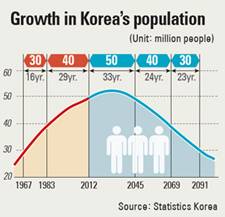
South Korea’s population hit 50 million at 6:35pm on Jun 23, thus becoming the 7th country in the world to join the “20-50 Club,” 50 million people and $20,000 in per capita income. Korea’s population was 25 million in 1960, 40 million in 1983, thus doubling the population in 50 years. Statistics Korea estimated that the population will decrease steadily after a peak of 52.16 million in 2030, falling to 40 million in 2045, and 30 million in 2069. Many fear Korean economy would stop growth due to low birth rate. Korea’s total fertility rate (TFR), the average number of children a woman is expected to bear between 15 and 49 years of age, will stand at 1.23 from 2010 to 2015, much lower than 2.08 for the U.S., or 1.56 for Russia. It is even lower than one baby policy China which has 1.53.  
   
South Korea had pursued strong family plan policy until late 90’s as its land size is about the same as Indiana with 10 million people more than California’s, ranking the 3rd in population density after Bangladesh and Taiwan, if small city countries are excluded. Men were given from condoms at a week long reservist trainings and even exempted from the tough training if they came with a vasectomy certificate. Not sure about young people in reservist training these days, but they might be given free Viagra instead.   

2) Korea benefits from FTA with U.S.
It has been over three months since FTA with U.S. went effect on 15 March. South Korea’s exports to the U.S. have risen 8.4% from Mar 15 through Jun 15 compared to the same period last year, while total exports, excluding those to the U.S., fell 2.5 % over the same period.  Import from the U.S. dropped by 6.3%. A government official said exports of key items like automobiles and petrochemical products to the U.S. increased by 16.8 percent, leading the growth in total value.  FTA with EU was not that much favorable to South Korea, as exports declined by 12.1% while imports from the EU increased by 13.5%. Economists think the recent European crisis was the prime reason for less exports to EU market. 
 
 One of the main reasons for the growth in import from Europe was consumer goods such as handbags, shoes, watches and cosmetics made by European companies which increased its export to Korea by 10 to 30 percent. The recent economic growth in Italy could have been worse had my wife made fewer visits to Gucci and Prada stores in Seoul. 

3. Auto Industry
1) Kia’s 3rd plant got its ground broken
Hyundai-Kia Chairman Chung Mong-koo was in Yancheong in Jiangsu Province in China for the groundbreaking ceremony of Kia’s No.3 plant. The new plant with 300K units a year capacity is to be completed in mid 2014, increasing Kia’s annual capacity to 700K units a year. Kia is running its operation in Yancheong in a joint venture with Dongfeng Yueda Motors. Kia’s sales in China went up from 101K in 2007 to 432K last year.  In the mean time, Mr. Chung will fly to China again next week for the grand opening of Hyundai Beijing’s 3rd plant. With the 400K a year 3rd plant, Hyundai Beijing can now make as many as 1 million units a year. 
   
Hyundai and Kia have their overseas operations all over the world. In the sequence of grand opening, they are India, Turkey, Yancheong, Beijing, Alabama, Slovakia, Georgia, Czech Republic, Russia, and Brazil. However, Hyundai’s first overseas operation was Bromont plant in Quebec shown in the above picture. Its ground breaking ceremony took place on Sep 16, 1986, and grand opening on Jul 4, 1989. Too bad the plant closed in 1993 after the total production of 99,997 units of Sonata, but the Hyundai employees from Bromont were the seeds of the following successful overseas operations.  

2) Hyundai slips in J.D Power quality survey
Hyundai’s quality image got a hit as Hyundai ranked 18th, down eight notches from last year, in JD Power 2012 Initial Quality Study.  Kia maintained the same slot as last year to rank joint 18th with its sister Hyundai. The IQS survey is made of 228 questions that analyzed the number of problems per 100 vehicles reported by car owners. Both Hyundai and Kia had 107 problems, a bit higher than the industry average of 102 problems among 34 brands surveyed. Lexus was the best with 73 problems per 100 vehicles, followed by Jaguar, Porsche, Cadillac, Honda, Acura, Infiniti, and Toyota.
 
What is painful to Hyundai is that it ranked impressive fourth in 2009, but has slipped continuously since then, to 7th in 2010, and 11th in 2011. HMC must be in high alert after the JD Power 2012 IQS report. The hospitals near Hyundai-Kia headquarters are in 24 hours/ 7 days operation mode to treat patients with blue eyes, and broken ribs. 

Regards,
H.S.


Monday, June 18, 2012

LTW - Greater Wall, Jinro Champs, & Renault Swamp


1. National
1) China extends its Great Wall length to Korea’s former territory
Koreans were not happy at the Chinese government’s announcement that Great Wall’s length has increased to 21,196km(13,170 miles), more that twice of what it was known, because China was adding the length in its Northeastern region of China where Koguryo Dynasty (B.C37-A.D 668) once ruled. Koguryo is considered Korean history by Koreans. Korean scholars think this is part of Chinese government’s Northeast History Project based on the premise that all history that happened in the current Chinese territory is all its own. Korean government said it won’t tolerate a distortion of Korean history and will respond after studying China’s claim more in detail.


Americans better watch out. The Chinese government may even extend Great Wall’s length by another 6,000 miles, claiming it reached as far as New York City because one of its main streets has “Wall” on its name.

2) Korea ranks 42nd in Global Peace Index
According to the Institute for Economics and Peace report, South Korea has moved up eight notches to rank 42nd in the London based think-tank’s 2012 Global Peace Index that measures how peaceful and harmonious countries are. The countries are ranked in seven categories such as international conflict, military expansion, war-time casualties, degree of crime, public security and public order. Iceland was the most peaceful nation, followed by Denmark, New Zealand, Canada, and Japan. Somalia was the least peaceful country, and was preceded by Iraq, Sudan and Afghanistan. North Korea was ranked 149th, just one spot more peaceful than Afghanistan.

It was lucky South Korea’s GPI rank was decided before what happened between me and my wife last Sunday when she came home with a couple Prada handbags in her shopping bag. South Korea could have been a challenger to Somalia otherwise.

2. Economy
1) Jinro Soju becomes world’s bestselling spirit brand
Jinro and Lotte, the two top soju makers in Korea, became the No.1 and No.3 spirits makers in the world, according to a British research firm Euromonitor. It found that Jinro ranked top with sales of 61.38 million boxes, 2.5 times more than 2nd ranked Smirnoff vodka whose sales totaled 24.7 million boxes. Lotte came third with 23.9 million boxes. One box contains 9 liters. While vodka is consumed worldwide, most of soju is consumed in Korea. The combined sales of Jinro and Lotte totaled 85.28 million boxes, meaning 25.6 liters of soju for each of 30 million Korean adults. The WHO put Korea 13th in the world in liquor consumption, but 1st when it comes to strong spirits.

I’ve experienced two major blackouts from too much alcohol in my life. The first was in Oct, 2007 after I had cut 70% of production employees due to significant drop in customer demand. The other was in Feb this year at a wine bar in Barcelona when I drank next to Mr. Amato, the CEO of Metaldyne. I still can not remember what I did or said at the bar, but my colleagues told me I gave Mr. Amato an hour of class on how to run the company.

3. Automotive Industry
1) Renault Samsung keeps falling in the swamp
While Hyundai and Kia keep breaking its production records, Renault Samsung Motors keeps expending its no work holidays as RSM announced again it will idles its plant in Busan for four days a week from June 15 due to excess inventory. RSM plans to work only on Tue, Wed and Fri, letting employees have off on Mon and Fri. RSM’s domestic sales dropped 38.3% on-year in the first five months, and its exports also dropped 20% due to crisis in Europe where 20% of RSM’s exports are being made. RSM is now at the risk of being overtaken by Ssangyong Motors’, the smallest auto maker in Korea, which trailed RSM only by 500 units in May.

There are three problems with RSM. Its line up offers only four models while its competitor Hyundai has 13, Kia with 14 and GM Korea with 10 models. RSM imports many of the components from Japan when high yen is on going. RSM also has to pay 92.9 billion won to Renault and Nissan as a royalty even though RSM made 215 billion won loss last year. Carlos Ghosn may have to have a lot of wine with me.

2) Hyundai recalls airbags in China
Beijing Hyundai issued a recall for 97,542 units of Yuedong, Chinese version of Elantra, produced from Mar, 2008 to Jan 2010, for air bag problems. It was the third major recall for Hyundai in China. The first was with 98,559 units in 2006 for defects in starting devices, and 9,280 vehicles in 2010 for problems in water temperature sensors. Hyundai Mobis and Autoliv are the two major airbag suppliers to Hyundai. Mobis buys many of key airbag components from TRW and Key Safety Systems, formerly Breed.

Quality has been Hyundai’s No.1 policy as its chairman firmly believes the continuous quality improvement ever since he took the ownership in 1999 was the driving force behind Hyundai’s growth from a dwarf to Goliath. I almost got hanged a few weeks ago at Hyundai quality meetings for supplying noisy parts. With the airbag recall announcement last week, a few Hyundai quality people were busy moving around electric chairs.

Regards,
H.S.

Tuesday, June 5, 2012

LTW - Pro-NK Critics, Electricity Hike, & Japan pays damages

1. National
1) Pro-North Korea followers criticized
President Lee Myung-bak made criticism against those in South Korea who exhibit blind support for Kim Jung-un regime. In his radio address, Lee accused North Korea for denying its responsibilities for the 1983 bombing in Myanmar and the 2010 sinking of a South Korean naval ship, and said he is even more worried about some South Koreans who blindly support the North positions. Lee’s comment came after a month long controversy over Mr.SK Lee and Ms.JY Kim, the hardcore North Korean followers in the Unified Progressive Party who became proportional lawmakers recently through rigged UPP’s internal nomination process. Koreans fear that the sensitive national secrets might be passed on to North Korea through Mr.Lee and Ms.Kim in National Assembly. Confronted with falling party approval rating, the leadership in UPP is demanding the two resign, but they are sitting like 10,000 ton rocks.
There are five subjects pro North followers are brainwashed to keep mum about; Succession of power from Grandpa Kim to father to grand son, self reliance doctrine, political system, human rights and Dear leader. The North followers are, however, instructed to sing at higher decibel than Luciano Pavarotti for any other issues that can threaten the stability of South Korea.

2) Conscripts during Japanese colony win damages
The Supreme Court ruled in favor of eight Korean men who for 17 years have sought compensation from Japanese companies that used them as forced laborers during its colonial era from 1910 to 1945. The court said Mitsubishi Heavy Industries and Nippon Steel the plaintiffs sued are still responsible for paying them wages and damages. It was a historic verdict as it was the first time Korean conscription victims won a court battle against their Japanese employers. Japanese government made an announcement soon after the ruling that the issue of conscripted laborers had been completely resolved in an agreement between South Korea and Japan in 1965. South Korean government is caught in dilemma as the ruling has no validity as Korea’s constitution states the conscription during the colonial days were illegal.
Japanese gave $800 million, a huge sum for Japanese economy at that time, to South Korea in 1965 as a compensation for the suffering of Koreans during the colonial days. This compensation was well spent as most of the money was invested for steel mills like POSCO, automobile plants like Hyundai, electric companies like Samsung and other infrastructures like Seoul-Busan highway. It could have been a disaster if the money were evenly distribute to each of the then 30 million South Koreans. What about compensation negotiation with North Korea? North Korea still got no compensation because of no diplomatic tie with Japan, and that’s one of the key reasons the North fell far behind the South even though it was much more affluent than South Korea until the early 70’s.

2. Economy
1) Electricity price to be hike to dampen its usage
With demand for electricity surging to the temperature rising up, the government is considering the hike of electricity price by 5 percent for both households and industries. The government said it will try to collect 400,000 more kilowatts from private companies’ generators, but it would be too small for the 4.8 million KW more demand expected this summer than last year. Thanks to the lowest electricity price among OECD nations, $0.058/kWh in Korea compared to the most expensive Italy’s $0.258, the average Koreans consume 9,510 KW a year while the OECD average was 8,272 KW in 2010.The government is trying to find ways to curb the reckless consumption of electricity, like air conditioning in the open area. Seoul city is enforcing “short pants, no ties” dress code during the summer.
Korea has to import 100% of petroleum to run the power plants, and its price keeps increasing. It is thus natural that the electricity price goes up, but the government is hesitant because of possible complaints from the people who are used to sweet candies for too long. A Korean saying has it that good medicine tastes bitter, and Koreans need to practice the proverb. More so with Greeks these days.

3. Auto Industry
1) Hyundai retorts against media report on zinc plate steel sheet
Hyundai said it is using the zinc plated steel sheets to build the chassis of cars for both domestic and export from 2006. Hyundai’s announcement came after a local newspaper’s critical report that Hyundai used low cost non zinc coated sheets for domestic models, but more expensive zinc plates for exports. Hyundai said, as of 2011, it has extended the use of zinc sheets, which are 15% more expensive than regular sheets, to include all of its vehicles even though local anti-corrosion requirement is not as strict as that of North America where much more corrosive calcium chloride is sprayed on the road due to heavier snowfalls.
Korean consumers have long suspected that Hyundai’s export models are better than domestic ones. They are not well aware that Hyundai or other car makers build their vehicles to the laws, regulations and the needs of the regions its vehicles are marketed. What’s the use of air conditioner for cars sold in North Pole?

2) Sonata hybrid wins top points in the U.S.
Hyundai announced its Sonata hybrid won the “top satisfaction” award from the U.S. based research company AutoPacific. According to AutoPacific, Sonata hybrid ranked #1 in the hybrid and electric-powered car segment. This car segment was first launched in 2010, with the Mercury Milan hybrid and Lincoln MKZ hybrid as the first winners. The AutoPacific Vehicle Satisfaction Award is an industry benchmark for measuring how owners feel about their vehicles after checking 48 categories covering safety, quality, performance and comfort.
One of the main reasons Hyundai products keep getting recognized by the media is its ever improving quality reputation. We recently had a quality problem that made engines a little bit noisy, and HMC quality engineers landed on Metaldyne Korea at the same speed my wife jumped into a Louis Vuitton store a while ago.

Regards,
H.S.