Monday, March 19, 2012

LTW - SK/NK Tensions, Naval Issues, FREE (trade) AT LAST

1. National


1) Tension grows between South and North Korea
Spring came, but it gets colder in Korean peninsula. Mad at scrawled threatening slogans of their new leader Kim Jung-un and his father Kim Jong-il in a South Korean army unit, North Korean TV aired footage of soldiers shooting at banners with slogans, “Let’s bet up traitor Lee Myungbak and South Korean military jingoists!” Some 150,000 people gathered in a square in Pyongyang, the largest crowed since the funeral of the late leader Kim Jong-il. The North Korean People’s Army also threatened “a sacred war to bury the traitors in this land.” South Korean minister of defense vowed South Korea would annihilate not only the origin of missiles fired, but also the areas supporting missile firing, meaning Pyongyang itself, if the nation is attacked. Mar 26 is the two year anniversary of a South Korean submarine sunk by North Korean torpedo, and South Korean and the U.S. forces are having a large scale exercise currently.
North Korea just announced it will launch a rocket in April to carry a satellite into orbit to mark the centenary of North Korea founder Kim Il-sung, Kim Jong-un’s grand father. So the remarkable tradition of Kim family’s flirting with fire works continues from 1945. Like grand father, like father, like son.

2) Groundbreaking of controversial naval base
Total of 112 simultaneous explosions ripped through the seashore of Ganjeong Village on Jeju Island, signaling the beginning of full-scale construction of a naval base that has become a flash point between the government and the opposition. The construction of the naval base about 130 acres of land at a cost of $869 million has faced extreme resistance from the opposition parties that say the base threatens the peace of Jeju, Korean Hawaii. The government says the base is needed to boost national defenses in the South Sea, especially in the event of possible sea conflict with China. 
Kim Ji-yoon, a member in left wing Unified Progressive Party, is widely criticized after she posted a tweet that described the naval base as a “pirate base.” If she is right, some 10 employees in Metaldyne Korea are former pirates, and some 100 employees from the army are former bandits. Being the leader of bunch of pirates and bandits, I am a Robin Hood.


2. Economy

1) Korea-U.S. FTA takes effect finally
It took 4 years and 10 months before the Korea-U.S. FTA officially goes into effect at midnight on Mar 15. Tariffs will be removed immediately on 9,061 products of 80.5% of U.S. imports to Korea, and 8,628 products of 82.1% of Korean exports to the U.S. Economists estimate Korea’s GDP will increase 5.7% over the next decade due to the FTA, and 350,000 jobs will be created. However, opposition party is still against the FTA. Han Myung-sook, the leader of opposition Democratic United Party, announced that her party will repeal the FTA if they win the general lawmaker election in April, and the presidential election in December. An irony is that Han had said “FTA with the U.S. is the right way to go” when she was the prime minister in 2007 under late president Roh Moo-hyun whose government initiated FTA negotiations. Han was probably not happy that the FTA went into effect by the government ruled by her rival party.
What’s wrong with Korean women these days? A young lady who calls navy of her nation “pirates, an opposition party leader who has two mouths that tell conflicting stories, and my wife who has to stare at her mirror for two hours before one hour church service…….
3. Auto Industry
1) Return of Mitsubishi to Korea

I talked about Hyundai’s 2nd attempt into Japanese market two weeks ago. Now it is Mitsubishi’s turn as it signed a partnership with CXC Motors to sell its models in Korea. Mitsubishi also unveiled its RVR model at the Kintex center, for the first time, as well as Lancer, Outlander, Pajero and L200 pickup. “Korea is a fast-growing market, and I believe it will be a good opportunity for us,” said MMC president Osamu Masuko. Cho Hyun-ho, chairman of CXC, said the company wants to become the most recognized and best-selling foreign brand in Korea, as well as the automaker with the highest customer satisfaction. CXC has opened two dealers in Seoul, and plans to sell 900 units this year.


Though 7 million vehicles a year Hyundai can now laugh at 1.14 million Mitsubishi, Mitsubishi had been a big guru to Hyundai until 90’s. Mitsubishi provided engine and transmission technology, and dispatched a number of engineers to Hyundai. The most known Mitsubishi engineer was Arai san who brainwashed Hyundai engineers with his doctrine on manufacturing engineering, production and quality. For example, when a problem occurs, he put drew a 1m diameter circle and told Hyundai engineers to stay in the circle to watch the manufacturing process until the root causes are found. No toilet trip was allowed as it was part of punishment. Today’s Hyundai would not have been possible without Arai San who was also a play boy. Ask any Hyundai employee if he knows Arai san. If the answer is yes, he must have been in Hyundai for long time as Arai san left Hyundai in the late 80’s and is now flirting with Goddess in the heaven.


Regards,


H.S.

Monday, March 5, 2012

Last Two Weeks - Defector Tension, Mr. Choe Beats Hyundai, & Fewer Divorces

1. National
1) High tension between Seoul and Beijing over defectors
There are as between 50,000 to 100,000 North Koreans roaming in China. Tension is growing between Seoul and Beijing over the impending repatriation of dozens of North Koreans defectors. Fearing that they will be persecuted once sent to North Korea, South Korean government asked China not to deport the defectors. A strong supporter of Kim Jong-un, China rejected Seoul’s request, saying the North Koreans crossed the border for economic reasons. South Korea is pleading to U.N. and international communities to give pressure to China. Some 3,000 North Korean defectors have reached South Korea annually over the past five years, 2,737 last year.
Not sure why Hu Jintao is so eager to send the defectors back to North Korea despite international humanitarian protests? Is Hu afraid the 100,000 defectors might be a threat to China’s family plan, too many to 1.4 billion people China have?
2) An American Kimchi Fighter a star to Koreans
Hines Ward in Pittsburgh Steelers is a hero to Koreans because his mother is a Korean. So it was another hero born when Ben Henderson became the new lightweight champion in the Ultimate Fighting Championship (UFC) after unanimous decision victory over Franke Edgar in Saitama, Japan last Sunday. Henderson wore a T-Shirt emblazoned with the Korean flag on its right shoulder, and U.S. star spangled banner on the left. A tattoo on his left arm showed his name in Korean alphabet. His mother met his father while she was working on the bus commuting to and from the DMZ, and married him 1980. Henderson was born in the U.S. in 1983, but had a Korean style
upbringing, which included learning Korean language, eating Kimchi, and practicing taekwondo.

>

Koreans are physically less blessed than European and African Americans because of shorter legs. Just look at me. No Korean has won a medal in track & field in the Olympics, and a lousy high school basketball team in Detroit might beat Korean national team. International marriage with Americans might be encouraged as a solution for Koreans to succeed in the sports that
Koreans will never ever do well otherwise.
2. Economy
1) Divorce rate slows down
According to a report by Statistics Korea, there were 114,300 divorces last year, down 2.2% on-year and the lowest since 1997. The figure peaked at 166,600 in 2003, and stayed around 120,000 ever since. Experts think the “divorce deliberation” law enforced in 2008 was one of the main reasons for the divorce drop. The “divorce deliberation” law is designed to prevent the impulse divorces by mandating the couples filing for divorce to come  back to the court after three months. As per the marriage, there were 320,910 cases, the most in four years, reflecting better economy after Lehman Brothers.

I had the worst marital crisis in Nov 1989, just six months after marriage. My wife complained the humidifier I bought was too small, which I though was adequate, and it somehow flared up to an all-out war. My wife attacked me like Elin Nordegren, Tiger Wood’s wife, and I was Kimchi Fighter Ben Henderson. We finally made up for peace, but the ultimate victim was the poor broken humidifier that got thrown out the window in the middle of the fight.
2) An outsource worker wins against Hyundai in Supreme Court
The Supreme Court ruled in favor of Mr.Choe, who had been an irregular worker of an in-house subcontractor of Hyundai Motor. Choe filed a lawsuit against Hyundai in Aug 2006 after being “unfairly” fired after requesting the company make him a regular worker. The court said Choe had been working as an irregular worker of the subcontractor for more than two years for Hyundai, and thus should have been made a direct employee to Korea’s law that allows dispatched workers to be directly employed by the company if they have worked there for more than two years. While Hyundai said it respects the ruling, analysts think that it is impossible to turn all of its 8,000 irregular workers, which make up 20% of the total employees, into regular workers.


Union leaders have criticized companies of creating more irregular workers. Let’s see. An entrepreneur built a new plant in 2004. He had two choices in hiring. Hiring regular employees could guarantee better quality and less employee turnover, but it would cause all the union headaches that he had witnessed for many years in other companies. Hiring irregular workers would mean less quality or productivity, but he would not worry about all the nonsense from the union. He finally made a decision to hire irregular workers, and thus blamed as the villain who created irregular workers. Who is the real villain?
3. Auto Industry
1) Another poke at Japanese market
Hyundai has been successful anywhere in the world but Japan. Hyundai established Hyundai Motor Japan in 2000, and sold Santafe, Elantra and Sonata as well as Azera. Japanese customers were not impressed with Hyundai, though, and Hyundai had to pull out of Japan in 2009 in tears, selling only 15,000 vehicles in 10 years. Hyundai thought the pullout was a big damage to its pride, and is giving another shot at it. Cradle, a Japanese auto importer, announced that it will sell Hyundai’s i40 wagon through its 130 dealerships in Japan from April. The i40 sold only 1,840 units in Korean from its debut in September last year, but sold 11,895 units in Europe. An auto analyst said “Hyundai can take advantage of high Yen as the tool to re-enter the Japanese market.”
Japanese market is very tough to crack open, with total import models taking only 8% of the market. A Korean proverb says ‘No tree can stand after ten ax strokes.’ Hyundai might fail again even with Cradle dealers, but there are another 8 ax stokes to go before Hyundai finally says Sayonara Japan.
Regards,
H.S

Tuesday, February 21, 2012

Last Three Weeks in Korea - Girls, Marines, & Dodgers


1. National
1) Girls’ Generation debut in the U.S.
Korean pop group Girls’ Generation made their U.S. debut by appearing on CBS’ David Letterman Show and ABC’s “Live!with Kelly”, creating a big buzz. The band’s performance of the English version of the “The Boys” on David Letterman show was met with enthusiasm from the U.S. fans. The video clip from the show received over 710,000 hits in just two days. More meaningful as it was Letterman’s 30th anniversary for his show on Jan 31 when the Korean girls wowed the old man. The Wall Street Journal described the Korean girls’ appearance in the David Letterman’s show as “inroad by K-pop in the U.S. market.”
The two industries most lopsided in trade in favor of the U.S. are aviation industry, and entertainment. Most of the Koreans well know Frank Sinatra, Whitney Houston or Tom Cruise, but how many Americans have heard of Cho Yongpil, Lee Mija, or Jang Dongkun? The Girls’ Generation were the first Korean entertainers featured in major U.S. TV stations to my memory, and many hope it would be the beginning of the correction of entertainment imbalance between the two countries.

2) U.S. Marines to be deployed in Korea
The U.S. has its Army, Air Force and Navy in Korea, but not Marines. This may change as a South Korean official said the U.S. has wanted to deploy some of the 8,000 marines and their families from Okinawa to Korea on a rotating basis. Korean government is worried about the opposition from China and North Korea as well as from some South Koreans, mostly because the marines are usually for attack instead of defense, even though it believes that the U.S. marines can play a major role in an emergency in Korean peninsula.


Korean marines are as tough and brutal as U.S. marines, thus keep strong pride in being a marine. As “Once a marine is a marine forever” is one of their favorite mottos, I asked two of my ex-marine managers if they would like to rejoin marines. F words came out of their mouth immediately. (See if you can find the two ex-MKL managers in the picture.)

2. Economy
1) A Korean firm interested in buying L.A. Dodgers
Korea’s E-Land Group has announced that it plans to buy L.A. Dodgers. According to market insiders, E-Land formed a consortium with Former Dodgers owner Peter O’Malley, Joe Torre, the former manager of N.Y. Yankees, and Magic Johnson. E-Land plans to invest $100 million in the deal. L.A. Dodgers is put out for sale as the current owner Frank McCourt needs some cash for his divorce settlement. E-Land is interested in Dodgers as it is the most loved baseball team to Koreans. Chanho Park, Korea’s first major leaguer, spent seven years there from 1994 to 2001. Los Angeles is the city with most Koreans in the U.S.


E-Land started its business in 1980, by opening a small 6 sqm clothing shop near E-Hwa Women’s university in Seoul. Its business has now grown to 8.7 trillion won ($7.9 billion won) in sales in 2011. Its original name was England, but changed to E-Land due to restriction on trademark registration. Just in case you might wonder whether E-Land is a Korean version of RE/MAX.

3. Auto Industry
1) Hyundai Mobis to supply GM and Chrysler
Hyundai Mobis has signed contracts worth $1.07 billion with GM and Chrysler. This is the 2nd largest amount Mobis signed with foreign automakers. Mobis will supply GM with integrated center stack system, a key component that controls multimedia terminals in the vehicle. It will supply LED tail lights to Chrysler. A Mobis executive said Mobis scored highly in the price-performance ratio of their products in an open bid against giants like Delphi. Mobis has supplied part to Daimler (audio systems and batter sensors), BMW(tail lights), Mitsubishi and Subaru (lamps) and GM (Parking brakes). The biggest contract Mobis signed for foreign automakers was for chassis modules worth $2 billion for Chrysler in 2009.


Who would have more say? HMC is the largest customer for Mobis, but Mobis is the largest shareholder of HMC with 21% ownership. Not all HMC suppliers have to say “how high?”

2) LG Group into automobile business?
With electric vehicles regarded as the future of auto industry, LG Group, Korea’s third largest Chaebol after Samsung and Hyundai, is considering making inroad into the auto business. LG Chemical is making investment to capture 25% of the battery market for electric vehicles, with the opening of its U.S plant in Michigan. V-ENS, a subsidiary of LG CNS, plans to build an electric vehicle component R&D center in Incheon by the end of this year. LG U Plus started car infortainment solution development, and LIG has begun to reinforce its auto insurance and vehicle repair business. Hyundai is apparently not very happy with the activities LG is unfolding. Hyundai decided to use SK batteries for its new Ray hybrid model, instead of LG batteries used in Sonata and Optima hybrid.
 
  
The group name LG was formed in 1995 to combine Lucky Chemicals, and Goldstar, an electronics company. Who knows. LG Chairman Mr. Koo might get a lucky and hit gold in auto business.

Regards,
H.S

Monday, January 30, 2012

Last Two Weeks in Korea - January 30, 2012

1. National
1) Students in Seoul got liberation?
   Seoul Education Superintendent Kwak No-hyun proclaimed the controversial students’ human rights ordinance that bans any kind of corporal punishment, continuing his clash with the central government and many parents and teachers nationwide. It took effect immediately in all elementary, middle and high schools in Seoul. It prohibits discrimination against students based on gender, religion, age, race, whether they are pregnant or because of their sexual identity. The ordinance allows students to stage rallies and loosens dress and hair codes in schools. The most controversial part of the ordinance is the banning of corporal and verbal punishments, which many parents and teachers say will lessen teachers’ authority and lead to students getting out of control. Critics say that Kwak does not understand the realities in the class rooms. 
The leftist Mr.Kwak was released from four months in jail last week after being fined 30 million won for election bribery last year, and he is the head of education in Seoul. Paris Hilton preaching teenagers to keep virginity until marriage ……  
2) Europeans image on Korea
Korea Trade-Investment Promotion Agency(KOTRA) asked 1,208 young people from 18 to 30 in five major cities in Europe what would come up as the first image when they think of Korea. North Korea was the first image with 9.1%, followed by K-Pop(6.9%) and Seoul (6.5%). Korean War was the fourth with 5.4% followed by Samsung(5.1%), Kimchi(2.7%), 2002 World Cup (2.4%), Taekwaondo (2.0%), science & technology (1.4%) and automobiles (1.4%).
 
What if the same question was asked to Americans who have not been to Korea?  Not sure, but M*A*S*H would be one of the top 3 answers.
2. Economy
1) Chaebol criticized over penetration into corner store business
It is like GE selling pan cakes and GM running coffee shops. While anti-corporate sentiment is brewing also in Korea due to widening wealth gap, President Lee Myungbak lashed out at third-generation scions of Chaebol owners for driving small business owners out of business, criticizing them for lacking business ethics. Lee added “If conglomerates keep invading into mom-and-pop stores, the public will harbor hatred against them.”  Big companies need act wisely.  Probably scared, Hotel Shilla announced it will walk away from its bakery and cafe brand Artisee just a day after Lee’s tough warning. Hotel Shilla is owned by Samsung Chairman’s first daughter.
While Korean conglomerates were the locomotive of Korean economy for over half a century, they have not been well respected as much by the public. An irony is that, while people accuse Samsung or Hyundai for being greedy and unethical, they want their kids get a job with Samsung or Hyundai.
3. Auto Industry
1) Chaebol criticized over penetration into corner store business
   HMC announced that its sister company Hyundai Powertech will supply its 6-speed transmission to Chrysler for its new Dodge Dart from 2012, with total volume of 770K to 2018. This will be 1.2 trillion won in sales. Hyundai worked together with Chrysler for the development of its World Engine produced in GEMA plant based on Hyundai’s Theta engine in 2005, so this will be the expansion of their cooperation in powertrain business.
  Hyundai Powertech was established in 2001 as the auto transmission company to supply to Hyundai and Kia. Located in Seosan city, one hour drive south west of Metaldyne Korea, Powertech celebrated its 10 million-th transmission on Dec 5 in 2011. Chung Myungcheol, the plant manager in Kia Slovakia plant until last month, is the new head of Hyundai Powertech. Mr.Chung, no relation to Chairman Chung Mongkoo, has spent most of his career in purchasing ever since he joined Hyundai 36 years ago. He has made the Slovakia plant a huge success, and Chairman Chung expects Mr.Chung repeat in Powertech what he did in Slovakia.
Regards,
H.S.

Tuesday, January 17, 2012

Last Two Weeks i n Korea - January 16, 2012

1. National
1) Cow farmers in protest at low prices
Angered by plummeting cow prices, cattle farmers tried to release hundreds of cows in front of Blue House, Korean version of White House, laying the blame on President Lee Myungbak and FTA with the U.S. he signed lately. They are shouting “Mr. Lee, you raise cow yourself!” Most of the farmers were blocked by the police on the highway before coming into downtown Seoul, though. The price of hanwoo (Korean beef) dropped 30% from its peak in 2009 to 4.4 million won ($3,800) per 600kg. There are total of 3.3 million live cows as of December, an increase from 2.9 million in 2009. The Agricultural Ministry said the right number would be around 2.6 million. To help the famers, the ministry said they would be replacing import beefs with hanwoo for consumption in the military.
As Korea has very small land the size of Indiana, with 70% of the land covered by mountains, Korean farmers would have hard time to compete if there is no protection against the low cost import beefs. The same story with chickens or pork. The only remaining livestock Korean farmers would still have clear advantage against the import would be, well, dogs.
2. Economy
1) Korea with the most low wage earner ratio in OECD
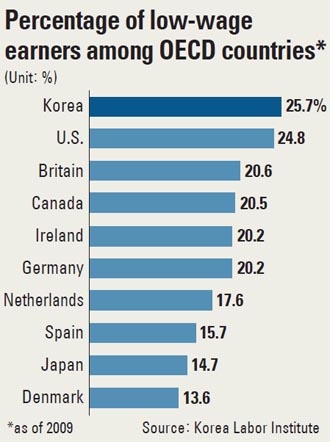
Korea Labor Institute reported that the ratio of low wage earners stood at 25.7% as of 2009, the highest ratio among the 34 OECD nations. Low wage earners are full time employees who ear less than two-thirds of the median age. The U.S. and Britain followed with 24.8%, and 20.6%, respectively. The report said the countries with higher levels of GDP and records of steep economic growth tend to create such poorly paying jobs. KLI added that “In most nations, low-paying jobs are persistent and recurring issues that can widen income and wealth inequalities.”
The key to reduce the number of low-paid workers is to lift the minimum wage. Korea’s minimum wage in 2011 was 4,320won (U$3.76), and will increase by 6% to 4,580won (U$3.98) in 2012. This number should be correct as this info came straight from my son who is working as a part timer at an auto supplier during this winter vacation.
3. Auto Industry
1) Hyundai gets the best news in a row
Hyundai Chairman Chung Mong-koo must be all smiles these days. Hyundai ranked No.1 for the first time in 2012 JD Power’s Customer Retention Study with 64%, pushing the likes of Ford, Honda and BMW aside. Hyundai’s Elantra won 2012 Car of the Year award at Detroit Motor Show, edging out Ford’s Focus and VW’s Passat. Chairman Chung has been named the second most influential person in Motor Trend’s 2012 automotive power list after Chrysler’s Sergio Marchionne. Despite the recent success in sales and quality, however, Chairman Chung is determined not to repeat the Toyota mistake, and is pushing its plants and suppliers for ultimate quality level. The new head of purchasing vowed in the annual supplies’ convention last week that Hyundai will treat its suppliers to the quality level each supplier demonstrates.
 I got kicked around last week when HMC visitors complained about Metaldyne Korea being not clean enough for ultimate quality level. I told my wife about HMC’s complaint and Elantra winning car of the year award. I got kicked around again, with my wife demanding full 8D report to explain why the heck then I left Hyundai.
2) Hyundai and Bosch to end its joint venture
A Hyundai official said Hyundai is seriously thinking about ending the JV relationship over KEFICO, a powertrain management systems components maker Hyundai, Mitsubishi and Bosch jointly set up in 1987. He added that Hyundai is reviewing the relationship over the JV business, and that Hyundai will still maintain supplier relationship with Bosch. KEFICO is currently 50:50 owned as Bosch bought Mitsubishi’s 25% shares in early 2000. The Hyundai official admitted that there has been friction with Bosch as Bosch has kept raising issues about using the Bosch designed products in Hyundai models. Analysts think that, while the separation can be a proof Hyundai can stand on its own in key powertrain technologies, there is a risk that Hyundai may be falling behind in world leading technologies without Bosch.
Bosch better think about ending the JV with Hyundai. Many foreign suppliers dying to become a Hyundai supplier as Hyundai plans to make 7 million vehicles this year, world’s No.5 with Ford and Honda behind. Here are three easy ways to become a Hyundai supplier. Hit one of them, and you will get a purchase order immediately.
*Your product is priced about half of what Hyundai is paying to current suppliers.
*Your product has technology that Hyundai has to have to sell cars.
*Your president is a very good friend of Hyundai Chairman Chung.
Regards,
H.S.